

1 At the start of September, the Recording Industry Association of America shared its 2026 mid-year report. Jumping out was data showing that CD revenue reached 58.6% during the first half of the year in the United States, reaching $171 million total. Here was a format, long declared over, appearing to rally long after its time of death.
To a certain type of jerk, this was cause for some “oh, I told you so” reveling. I am that kind of jerk. Images of the CNN article where the news agency explored Japan’s “obsession” with CDs and the dippy Vice article raced through my mind. Hey Billboard, wanna act like this is some kind of defect again? “Everything Is AKB48” theory remains undefeated, as does the Oshi Katsu Economy.
Yet my brain also went to another place because of this digital gloating…the year 2016. That’s because, a decade ago, the Japanese music industry actually underwent an epoch shift where the once internet-phobic space woke up to the online realities of the 21st century. Back then, stories about Japan’s CD reliance still felt alien, and today people like me hold them up as signs of where the West was actually heading.
In reality, though, CDs might still be a major player in the country…but this image of Japan is outdated all because of 2016, the most significant year in J-pop’s history this millennium.
2 As major changes tend to go, the early signs of something happening on this front emerged before 2016. You could look a year prior to see the YouTube-powered rise of the band Gesu No Kiwami Otome or the trend centered around Nishino Kana’s “Torisetsu,” wherein Japanese users took the song’s “this is the instruction guide to…my heart” and made it about being from Hiroshima or best practices for idol support.1 Go even further back to find AKB48 — an outfit held up at the time as everything backwards about J-pop — creating an extremely social-media-ready song and video in 2013 that predicts a whole slew of things. Vocaloid and Nico Nico Douga culture probably figures in there too.
Trends were pointing towards Japanese music’s new reality…but they didn’t coalesce until 2016, when seemingly every significant hit of the year achieved takeoff online.
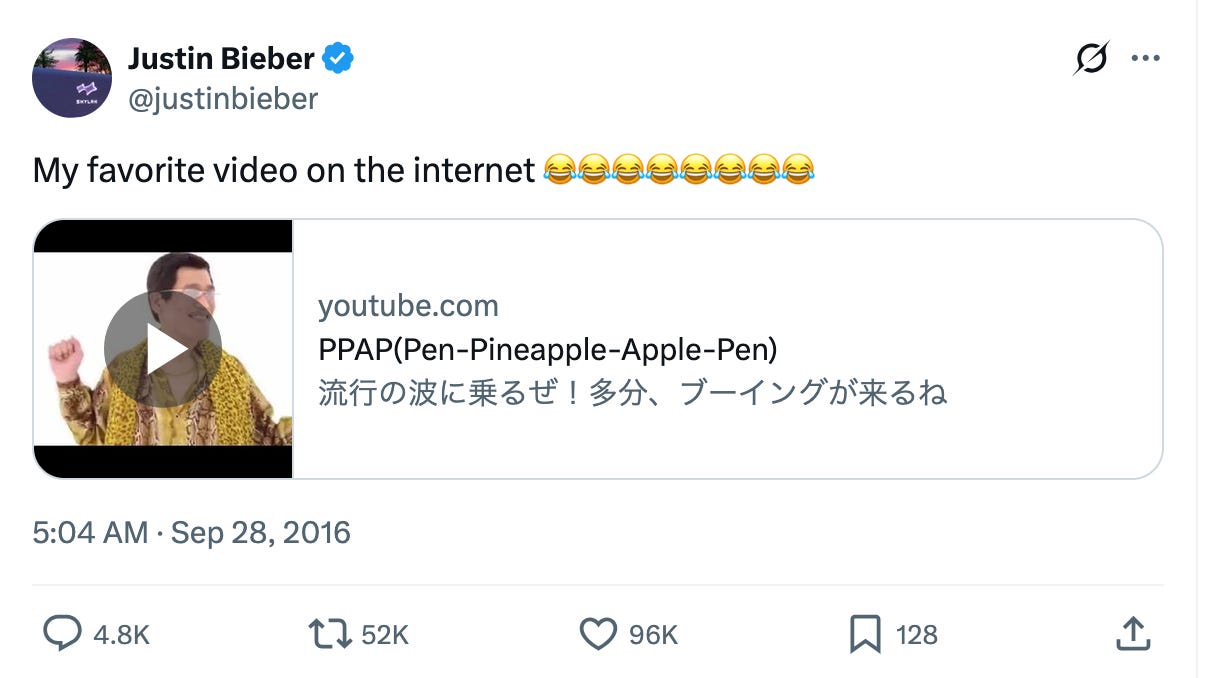
3 Let’s speed run the most important songs from this year, many of which double as the most memorable from 2016 a decade on. You had comedy-dance troupe RADIO FISH score an early viral hit with “PERFECT HUMAN,” debuted on a TV variety show but spread online via footage of the televised performance. At the same time, young Shonan band Suchmos wooed a new generation with “STAY TUNE.” BABYMETAL kept their online-presence punching with “Karate,” while Perfume scored its most viewed video ever with the karate-indebted “Flash.” Keyakizaka46 flipped female idol of the era from middle-aged fantasies to lived millenial experience with “Silent Majority.” Kenshi Yonezu underlined his pop-star bonafides with “Loser.” Hoshino Gen released “Koi,” put a pin in that one. And of course, Pikotaro took a pen, pineapple and apple to make a historic and geopolitically important bit of internet pop (and Justin Bieber’s favorite video on the internet).
The shared quality? All of them flourished on YouTube, which became the center of Japanese music this year.
4 The above reflected a major change both in the sound and system of J-pop. Making this even more clear is the Oricon Ranking’s top 10 best-selling singles of the year. This chart, still operating by only counting physical copies sold and pretending the internet didn’t exist, was in its twilight of mainstream relevance before it merged into the glorified fandom report it is today.
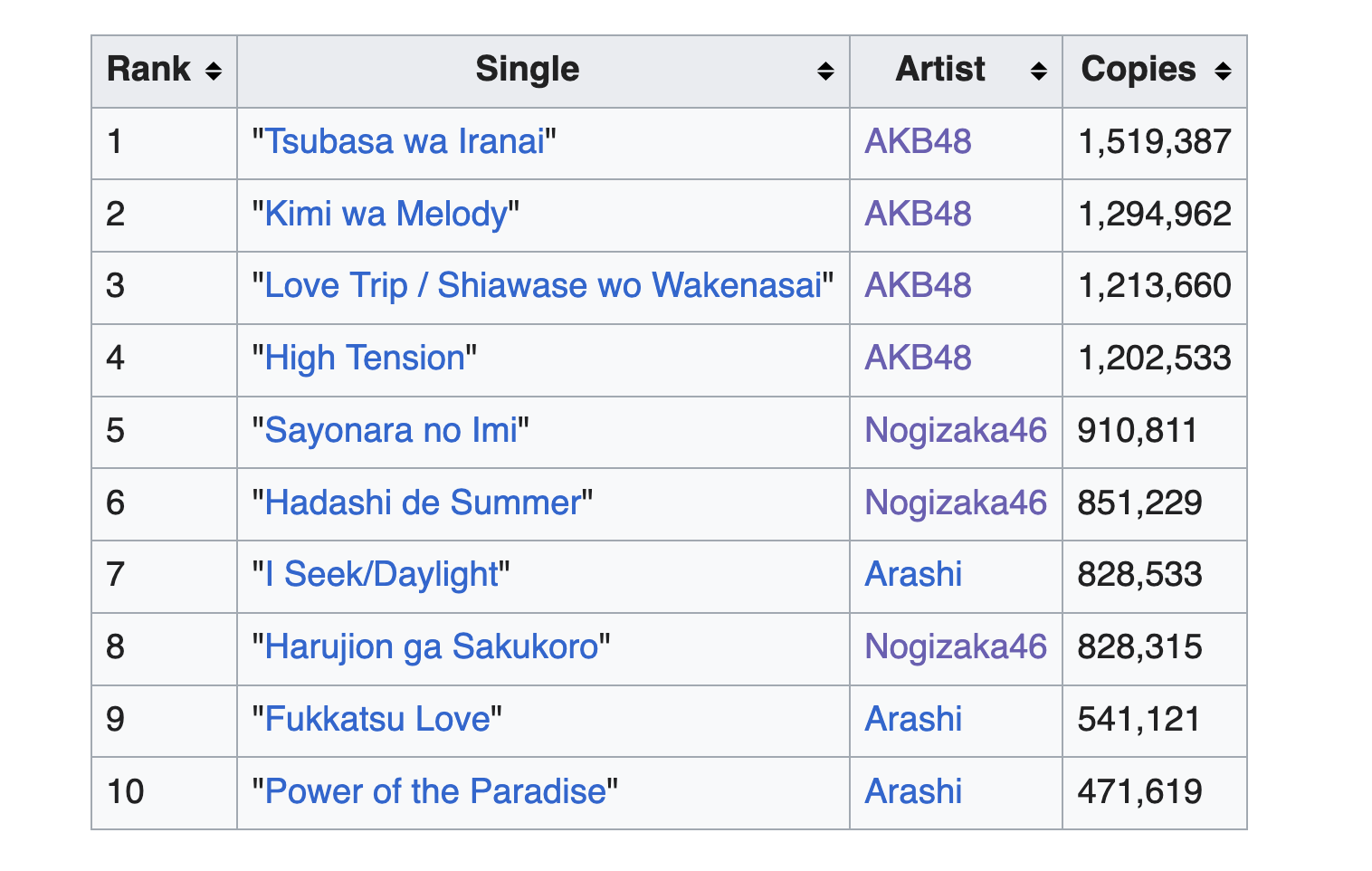
Just look at this…save for Nogizaka46, it’s dominated by two groups who by 2016 weren’t relevant to the zeitgeist. AKB’s imperial era was over, while Arashi was just…there, chugging along while their agency faced an existential crisis2. Most damning is the feeling that none of these 10 songs have any lasting impact, and were barely present at the time. Nogizaka at least was new…but still, compared to Keyakizaka’s breakthrough, these singles are like vapor.
5 In 2016, the period of J-pop dominated by Johnny’s groups and AKB-verse projects ended. Though really, the era of traditional media closed. For the first 15 years of the 21st century, a pop act could tower over the country’s entertainment scene via TV, magazines, movies and, of course, CDs. The men of Johnny & Associates weren’t just idols, they were omnipresent actors in dramas both small and big screen. Despite spending the majority of their existence learning to sing and dance, they would offer commentary on news shows and even pop up during, like, soccer matches to offer…expertise?
Meanwhile, the nation had already gone through multiple coverage cycles of discarded AKB singles being found in nature and people were questioning just how popular an outfit selling multiple copies of the same thing to the same people were…but AKB48’s members still dominated the mass media. I mean, they broadcast the yearly election on one of the major stations and treated it bigger than actual political elections at the time!3
Pop trends always fluctuate, but the real story in 2016 was the end of a 20th-century idea of media. It was a fitting symbol, then, for SMAP — a boy band described to me by a friend once as “more like Mickey Mouse than a pop group” for its cultural significance — to disband in spectacular fashion that year. Here was an outfit that used Heisei Era media perfectly to become an inescapable force, ending when that became an impossibility.
6 When I wrote about J-pop in 2016 for The Japan Times a decade ago, I touched on the fragmentation of media that, ten years on, just feels normal. The big story was how YouTube emerged as the go-to platform for younger consumers, and how the hits that actually defined that year emerged from it. It was also the year Spotify officially launched in Japan, joining a then-nascent race to make subscription streaming a reality in a place where it had long seemed like a fantasy. The short-form site MixChannel became a midway point between Vine and eventual space-crowder TikTok, largely used as the 2010s equivalent of puruikura but also a space for snack-sized music clips to get attention.
This was the digital age arriving in full force…but not fully replacing what came before. Rather, it worked best in tandem.
7 A decade on, Hoshino Gen’s “Koi” feels like the most telling song of 2016. Upon its release on Oct. 5 of that year (so…happy 10th birthday!), it was just the latest bit of zig-zagging pop from a guy who had gone from an instrumental indie-pop player to an emerging superstar. By New Year’s Eve, “Koi” was a phenomenon in large part because of the internet. Over chipper piano melodies and a Hosono-indebted “self-Orientalizing” guitar riff, people uploaded their own little silly dances to YouTube or MixChannel. It became a fully fledged force, cousin to that year’s Mannequin Challenge albeit with movement. Even the US Embassy in Japan got involved…opening with then ambassador Caroline Kennedy (daughter of John F.) dressed as Santa.
Where did this dance come from, though? Remember, this was 2016…the era of “TikTok dances” had yet to arrive, and nobody had delusions of this being “organic” or cynical enough to believe it was cooked up in a PR company’s meeting room. Nope, this little finger-moving choreography came from…a Japanese drama.
Nigero Wa Haji Daga Yaku Ni Tatsu (translated into English as The Full-Time Wife Escapist4) premiered about a week after “Koi” came out. It starred…Hoshino Gen, making this a multi-media boon for the talent. This became the hit TV show of the season if not the entire year, and the “Koi dance” — which you can see above — became a smash online. Yet it emerged from broadcast television and a synergy between actor/artist that Johnny’s had mastered by this point…but deployed by a guy from Kakubarhythm.
7.5 Which…actually seems like a precursor to today’s monocultural behemoth Mrs. GREEN APPLE. Yes yes this is partially an excuse to link to my interview with them again, but the whole reason they’ve come to define the 2020s in J-pop is how they are a rock band playing with idol ideas…or maybe, an idol group with a rock background. Either way, this duality has made them avoid being pigeonholed by either side, and instead bringing the two together.
That’s exactly what Hoshino Gen did in 2016 too, albeit in a more traditional way (GREEN APPLE used digital releases to really fly up the cultural pecking order).
Back To 7 “Koi” was a massive hit — probably the hit for that year — largely because of television, but that’s not reflected in any traditional chart. Look at those Oricon year-end numbers again. This clears all of them in terms of impact, but if history was still decided by charts alone, it wouldn’t come through.
That’s where the rise of digital in 2016 becomes essential — popularity still came about through stuff like TV tie-ups, but it truly turned into a cultural supernova online, where actual users could embrace and remix it themselves, and actually taking control of pop music. From “Koi” onward, this is the new normal.
8 The internet is vital to furthering J-pop hits at home and abroad in the 2020s…but pretty much every year-defining smash of this decade is still tied-up with something that could be linked with old-school media. With a few exceptions5, the nation’s biggest songs from recent years benefited from TV or movies. They just spread further thanks to social media. And that includes internationally, where media mix-ups have pushed J-pop further internationally than ever before.
That’s because of anime…and once again, 2016 seems like the genesis for where we are now in regards to that.
9 In the early 2010s, I’d sometimes go to Animelo Summer Live, a big ol’ celebration of “anime music” aka “anisong.” I was sent by MTV 81, and as someone who at the time was largely interested in like Jesse Ruins and Pa’s Lam System but also kept an eye on Music Station weekly, Saitama Super Arena felt like another dimension. Voice actors and bands who didn’t intersect with either the mainstream or indie became gods. Linked Horizon might as well have been Arashi to these punters.
For a while in the 2010s, “anisong” and J-pop proper had distance. That changed in 2016.
Of course anime and J-pop had intersected in the past, but before Your name. came out, there was an honest-to-goodness separation between the two in the 2010s. I remember talking with people involved with very popular acts at the time who refused to do anime songs, as it didn’t fit them. Then RADWIMPS made the soundtrack to Makoto Shinkai’s commercial breakthrough in 2016, and that would change.
Really, you could make an argument all Japanese entertainment changed in 2016, and I’d point to this movie as being particularly pivotal for that, as it dominated the box office in Japan and Asia (it became the highest-grossing Japanese film in China by the end of that December). Rock band RADWIMPS’ songs for it matched perfectly — when you need to capture the inflated stakes a teenager feels about their life in comparison to say, natural disaster, call on a group who had long nailed adolescent angst just right — and became just as popular. I said “Koi” was the most telling song of this year, but “Zenzenzense” might have equal claim to that one.
By 2017, I was now in attendance to watch RADWIMPS play a sold-out show at Yokohama Arena to write an article about them in the wake of the soundtrack’s success6. At one point vocalist Yojiro Noda asks which album fans got into the band through…ending with Your name. Dozens of sheepish punters respond. “Don’t be shy about it, it’s OK,” Noda says. “You’re here now.”
It’s 2016 when the link between anime and J-pop that is so central to how the industry works today formed.
10 Let’s do a speed round, shall we? Among all these big picture developments were a handful of smaller debuts that would prove to be monumental for the decade ahead. It was in 2016 where Warner’s unBorde label debuted a new singer/songwriter act in the summer, having her appear at an imprint concert held in Makuhari Messe. That night, she served as something like a chaser between more upbeat dance-pop and dour rock courtesy of Enon Kawatani’s groups. Yet soon enough, she would be bigger than anyone on stage that night.
This was the year Aimyon debuted7, and a year later she’d release the album that turned streaming in Japan from a niche to a viable platform. Let’s save that for 2027, though.
11 I mentioned Vocaloid briefly above…and I think that corner of internet music was in a weird place in 2016. Kenshi Yonezu was pushing into the spotlight, and a year later he actually returned to his Vocaloid producer moniker to release a song about…how Nico Nico Douga resembled a desert, the vibrant culture around it now barren. Creators like DECO*27 and PinocchioP were doing interesting things, but far from the mainstream. Yonezu was trying to bring his Miku-trained sound to a greater audience…and it was working…but one other artist also made a shift from the very-online to the very-real.
REOL, who got her start covering Vocaloid songs online, revealed what she looked like and aimed for pop stardom with her debut album. She’d teased this the year before…I interviewed her before she went full pop, but she was hinting at what was to come…but here she tried to move from the internet space into the mainstream while holding on to her digital roots.
She didn’t set Japan’s music scene on fire…though she has done pretty well for herself…but in 2016 she was basically prototype Ado, showing just how Vocaloid culture would eventually united with the mainstream.
12 It would be silly not to mention Fantome, Hikaru Utada’s big return album and among 2016’s best-selling releases. Yet that one actually kind of exists outside of everything above, save for it ending with a number made for Evangelion. It’s a deeply interesting album and one of the rawest full-lengths released by a J-pop act in the 21st century — bound to happen when you return to creating after the double life whammy of losing your own mother and becoming one yourself.
Yet it’s also a reminder of old ways that were starting to fade. Everything about it was controlled and measured — from the “short version” videos shared online to the secrecy surrounding it — and it was only available physically for a while. Good luck listening beyond a CD player. And my god don’t get me started on the Utada team’s treatment of press at the time. It always struck me as very funny that Utada’s big return happened at the same time as “PPAP,” a song that existed as the antithesis to the old world Utada’s team clung to and was also a billion times more present in the world.
13 Though really I write all of that because it was a different female J-pop veteran behind that year’s best pained collection of introspection…and she did not get the credit she deserved, and was actually kind of lambasted for it.
14 Looking at my top 10 from 2016…I think it mostly holds up. Ez Minzoku absolutely holds up and should be a Rate Your Music classic, so I feel good calling Foodman in the top spot. I like all the other albums, though I’d certainly shift a few things around…biggest oversight in retrospect is that Pachinko Machine Music — which I called an honorable mention — probably should be in the top ten, this one still fascinates me to this day.
15 I can’t fathom being a young person in 2026 who wants to return to 2016…but I kind of get it from a historical perspective. Let’s put aside the major political developments of the year that showed how the societal understanding of the past had been trampled (Brexit and Donald Trump)…from a purely entertainment standpoint, so much changed, all over.
I’ve outlined why it was so important for J-pop…but 2016 was every bit as important for K-pop, if not more so. This was the year where an industry that had started to enjoy global attention in the five years before — whether planned like Girls’ Generation meeting David Letterman, or unexpected like a certain galloping number — leaned further in to global expansion. Blah blah necessary to do so due to a smaller domestic market blah blah blah South Korea invested in high-speed internet earlier than most…I respect you reader, and figure you also read these facts a bazillion times when they were trotted out in “K-pop, you heard of it?” stories from a decade ago. The key in 2016 was a newfound focus, with multi-national outfits like TWICE designed for continental domination (geopolitical hiccups happening, though), or the debut of BLACKPINK, a group geared towards global listeners and global brands who could use some new spokespeople. It was the year BTS really took off, and although they weren’t eyeing a bigger crossover at this point, the potential for one was becoming clear…and which would set in motion everything Korean music accomplished in the ten years ahead.
K-pop committed to go international in 2016, and you can draw a line from “Whistle” to KATSEYE. It would alter the direction of the whole industry, and the sound itself.
16 J-pop made a similar decision in 2016, one shaped by slower adaptation of online trends and a much more robust home market. It would look inward and create music…out of step with global trends, almost the exact opposite of what Korean companies would be doing. All of these big online developments were just now being embraced at home…something like “PPAP” was a happy accident, but not the norm.
Yet there was a shift towards more unique sounds, one that didn’t play well abroad save for the viral success of Pikotaro and the niche (but like, BIG niche) of something like BABYMETAL. The internet as central hub meant a greater variety of sounds — ones not pushed forward by AKB48 or any Johnny’s group or LDH — could flourish. In the years ahead, it would only get odder, whether from Eurobeat mutations or Vocaloid-indebted dramatics or 21st century laments. By the 2020s, it turned out by being a kind of pop Galapagos — one where rock flourished, and a whole ecosystem built around singing synthesizers and idols could meld with the mainstream. In an entertainment landscape of flattening out, this helped Japanese music reach new global heights.
That all started in 2016. Everything happening today emerged from what happened a decade ago, and which helped give modern J-pop its unique flavor in a musical world often watered down.
Written by Patrick St. Michel (patrickstmichel@gmail.com)
Twitter — @mbmelodies
Check out the Best Of 2026 Spotify Playlist here!
Though at the time, Nishino’s official full-length version…wasn’t available on YouTube, just a short upload.
No not that one.
This was good and fun though, and I actually wish this still existed.
I mean that’s how everywhere online refers to it now…but in a real “Berenstein Bears” moment I distinctly remember this being referred to as We Married As A Job! in English, to the point “Japan Twitter” (English speakers who always have to be mad about something online) were having digital fainting spells over it. And that is exactly what appears on promotion from the time!!! But at some point the English name changed to something much, much clunkier (but a bit closer to the actual Japanese).
First off, huge asterisk needed for the COVID-19 years of 2020 and 2021 — I’ll defend both to death, but YOASOBI’s “Yoru Ni Kakeru” and Ado’s “Usseewa” benefited from once-in-a-lifetime global crises (with both scoring hits in the years after with works attached to TV series and film respectively. Second…I don’t think this year has something that fits the bill either. I think that’s thanks to the resurgence of idol music, but groups not from the STARTO universe (who monopolize media tie-ups), especially M!LK. I wonder if 10 years from now we look at 2026 as another pivot point…
And, full disclosure, said article led to me being hired as the band’s English-language bio writer, which I still do today.
With a song featuring an opening salvo of lyrics about…someone jumping off of the top of a building to their death. So yeah the 2020s dour turn J-pop took peaks up here.